
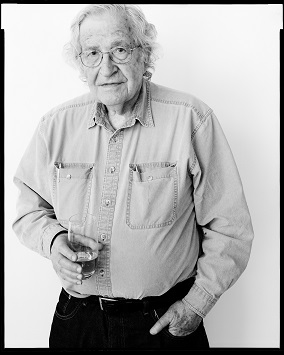
| We live in a world of irrational financial
markets, dominated by the herd instinct, which today seriously
threatens the global economy. But we have political remedies to cure
such economic ills. Those were two key points stressed this week by
Prof. Noam Chomsky on his two-day visit to the University of Calgary.
In his Tuesday night James S. Palmer Lecture, Chomsky delivered a
stimulating, wide-ranging and devastating
critique> of the
state of global capitalism.
Although he's a world authority on linguistics and philosophy,
Chomsky is also a controversial media analyst and outspoken left-wing
critic of U.S. foreign policy. To an attentive audience of 3,400 on
Tuesday, and in greater detail in an exclusive Herald interview
Wednesday, Chomsky chose to focus on the escalating damage being done
by unfettered finance capital. Tuesday night's crowd was a surprising
turnout to hear a man whose views veer far to the left of the
mainstream and are seldom heard or seen in daily papers or on network
television. Chomsky is simultaneously famous and obscure. He is
celebrated but he's definitely not a celebrity. As Institute Professor
at the prestigious Massachusetts Institute of Technology, Chomsky's
academic work has had profound impact across a spectrum of social
science disciplines from language philosophy to the psychology of
child development. He's the most quoted academic alive. He's compared
with the likes of Einstein, Galileo and Newton. In left-wing circles,
Chomsky's political work has also had a huge influence. He's known
through his speeches, radio talks, interviews and prolific writings
but he's seldom read, heard or seen in mainstream American media.
Despite his political brilliance he's anything but a confidante of
the president or a darling of the Republican party. In fact, his
scathing critique of modern-day capitalism and his devastating and
detailed analysis of the way the system works for a few at the expense
of the many, has placed him permanently on the margins of what passes
for acceptable political debate particularly in the United States.
None of this is surprising or unexpected to Chomsky. His status
conforms to what would be expected to follow from the "propaganda
model" he and co-author Edward S. Herman spelled out in their 1988
book, Manufacturing Consent -- The Political Economy of the Mass
Media [(Pantheon, 1988)]. That book argued that ruling classes in
liberal democratic societies -- Canada, the U.S., Western Europe and
Japan -- which do not rely on direct force and coercion to rule, rely
on sophisticated systems of persuasion to win and keep the "consent"
of the people for their government and corporate policies. The media
are to literally "manufacture consent" by establishing the boundaries
of the public debate, making sure certain agendas (mostly corporate)
are followed while others never or rarely get to the table. Crudely
stated, Chomsky/Herman's propaganda model states that media -- owned
by a few very large organizations, financed by equally large
advertisers, have the power to decide what constitutes news and to
listen to selected official sources while ignoring others. Media are
disciplined by well-funded corporate think-tanks and ongoing campaigns
against "evil bogeymen" such as Communists, narco-traffickers or
international terrorists.
This makes it very difficult for the public to engage in meaningful
public policy discussions on issues of social importance. It puts
tight limits on what can and cannot come into the arena of official
public debate. It also means that Chomsky's own social analysis, which
is not easily summarized, does not readily fit within the established
framework of news and commentary. Nevertheless, Chomsky's historical
look at the current turmoil in the stock market, as he laid it out
this week, cannot be lightly dismissed.
"There are fears of a global meltdown," he told the crowd Tuesday.
"It might affect privileged folks like us, instead of just the usual
victims. Therefore it's news."
He said the crisis originated in the Nixon administration's
decision in the early 1970s to remove restrictions on capital flows,
breaking the post-Second World War international economic structure
set in place under an agreement hammered out at Bretton Woods, New
Hampshire, in 1944. Bretton Woods established the International
Monetary Fund, the World Bank and pivoted on the balancing concepts of
free international trade and restricted international capital flows.
According to Chomsky's argument, organizers of Bretton Woods realized
that free trade and free capital flows were incompatible. Short-term
capital investments and unrestricted capital flight would undermine
investment and trade. "You can't liberalize both." Bretton Woods
fostered the "golden age of postwar capitalism" in the '50s and '60s
but when the Nixon administration began to remove restrictions on
finance capital movements it began a shift away from investment
capital toward speculative capital. "That was the big change in modern
world history. Since then the influence of finance capital has grown
astronomically. The consequences are even hitting the rich people and
that's where we are now."
In 1977, Chomsky estimated about $ 18 billion a day was involved in
foreign-exchange transactions. Today, estimates range between $ 1
trillion and $ 1.5 trillion a day. "Nobody knows exactly. These are
estimates by international economists and it depends a little bit on
what you count, but it's going up very fast. There's no doubt about
that." And the volume of the transactions is only part of their
significance. "Even more dramatic than the scale is the character.
Back around 1970, most of the international foreign exchange
transactions were economy related, 10 per cent ... were speculative.
"By 1990, it was estimated to be about 90 per cent speculative; by '95
it's supposed to be about 95 per cent." Speculative transactions are
very short-term and they are highly leveraged -- based on very high
debt ratios. About 80 per cent of the transactions last less than two
weeks. "A lot of it is days and minutes, which means it's just . . .
playing against, guesses against, slight currency changes and
interest-rate changes and so on."
"All of this is causing so much turmoil that in surprising places
you're getting strong opposition to it." He said prominent economists,
free traders, the World Bank and the World Trade Organization have
been criticizing the instability and negative impact on long-term
investment caused by the "lunatic ideas about liberalizing financial
markets." "Nobody understands (financial markets). I mean they are
motivated by herd psychology. You know, one guy leaves and everybody
rushes out. Their reactions are unrelated to economic fundamentals
very often," Chomsky said. Even more problematic is the associated
borrowing. "When all of this is highly leveraged, it can blow up in no
time."
Chomsky puts this economic situation in political framework. "There
have been perfectly reasonable proposals around for years as to how to
control this, even in very narrow and market-friendly ways." he says,
citing the idea of a small tax on short-term financial flows as
proposed by Nobel Prize-winning economist James Tobin. The Financial
Times of London has also proposed raising the capital requirements for
banks making international loans on these high-risk speculations. But,
for Chomsky, the point is political. "Governments certainly have the
power to control it. These are (political) decisions. They are not
like the law of gravitation."
One of the most useful political things to do, Chomsky suggests, is
join the resistance to the proposed
Multilateral Agreement on Investment (MAI) which, if it is passed
and adopted by developed nations, "is going to accelerate all this"
devastation by finance capital. "In parliamentary democracies like
ours these are decisions that can be made without fear of repression.
There's not going to be a military coup in Canada." |