
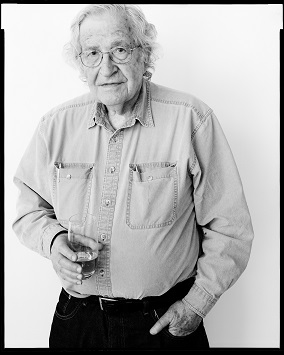
| Noam Chomsky is nothing if not consistent. Back in
the mid-1960s, a rising star in the American academy because of his
work in linguistics, he shocked his colleagues by taking a vocal
public stand against what he called "the American invasion of
Vietnam". In his 1966 essay "The Responsibility of Intellectuals", he
railed against the assumption underlying all mainstream discussion of
US policy in Indochina -- "namely, that the United States has the
right to extend its power and control without limit, insofar as is
feasible".
Ever since, while continuing to develop his liguistic theories, he
has been the most prominent US critic both of his country's foreign
policy and of the intellectuals and media that give it overwhelming
consensual support. "The Responsibility of Intellectuals" was followed
by a series of ever more devastating attacks on American policy in
Vietnam (collected in American Power and the New Mandarins and
At War With Asia): by 1970, he was far and away the best known
intellectual opponent of the US war effort.
After the US withdrawal from Vietnam in 1975, he expanded his field
of fire with a string of articles and books. All are worth reading,
but several stand out. In 1979, the two volumes of The Political
Economy of Human Rights, co-authored with Edward Herman, exposed
America's backing for Indonesia's war against East Timor, its
responsibility for the rise of Pol Pot in Cambodia and its support for
bloody dictatorships in Latin America. In 1982, Towards a New Cold
War subjected the US rearmament programme and its apologists to an
unrelenting political attack.
Next was The Fateful Triangle (1984), an assault on US
sponsorship of Israel's suppression of the Palestinians, which
prompted Zionist accusations that Chomsky was a "self-hating Jew". It
was followed by Turning the Tide (1985), opposing the US siege
of Nicaragua and support for death squads and dictatorship in El
Salvador and Guatemala. In the late 1980s and early 1990s came a
further batch of writings on the media (notably
Necessary
Illusions), Latin America (Year
501), the Iran-Contra scandal (The Culture of Terrorism),
and the cold war (Deterring
Democracy). A volume on the "new world order", World Orders Old
and New, is out in October (in Britain as a Pluto paperback).
Chomsky is a critic, not a policy-maker, a whistle-blower rather
than a strategist furnished with alternatives. Today, he is using all
his considerable powers of argument against calls for the US military
to go into Bosnia and Haiti. Although he backs the lifting of the UN
embargo on arms sales to Bosnia, he says: "I find it hard to take
seriously those people who are saying 'Let's intervene'. It just
happens that there's one country that's offered to send forces to
protect Bosnia -- Iran. I haven't heard anyone agree to that, and
there's a straightforward reason. If Iran were to invade Bosnia to
save it from Serbian attack, the result would not be pretty. The same
problems arise with anyone else."
As for Haiti, he comments: "The people there don't want US
intervention. They understand what it means, from bitter experience --
the end of the grassroots movements, the end of any hope of
democracy."
Chomsky has amassed an extraordinary body of evidence to show that,
since 1948, the US has operated a foreign policy of refusing to allow
radical nationalist third-world regimes to come between the US and the
raw materials needed by its industry. Military intervention has been
used consistently to this end -- and the media have given the policy
almost unstinting support.
But the single-mindedness of Chomsky's critique has unnerved many
commentators. Mainstream journalists get particularly hot under the
collar about his "propaganda
model" of the workings of the US media, according to which
television networks and the press slavishly defer to the government
line on every contentious foreign policy question. It's far more
complex than that, say the journalists. Chomsky will have none of it.
Every piece of research he and Edward Herman have conducted on media
coverage of Nicaragua in the 1980s shows "a degree of conformity to
power that would rarely be attained in a totalitarian state", he says.
"The only time that the propaganda model is falsified is when the
media turn out to be even more servile to the interests of the state
than we would expect."
Still more controversially, Chomsky has been criticised,
particularly from the right, for being soft on communism and
third-world authoritarianism. He has always concentrated his fire on
the US and has consistently argued for solidarity with the victims of
US policy. Where, ask the critics, are his polemics against the Soviet
Union's intervention in Afghanistan, Pol Pot's genocide, Cuba's
drug-running or the PLO's terrorism?
Chomsky dismisses this line of criticism out of hand. "If you look
at all of the stuff I wrote about the Vietnam war, there's not one
word supporting the Vietcong," he says. "The left was all backing Ho
Chi Minh: I was saying that North Vietnam is a brutal Stalinist
dictatorship. But it wasn't my job to tell the Vietnamese how to run
the show. My view is that solidarity means taking my country, where I
have some responsibility and some influence, and compelling it to get
its dirty hands out of other people's affairs. You give solidarity to
the people of a country, not the authorities. You don't give
solidarity to governments, you don't give it to revolutionary leaders,
you don't give it to political parties.
"The point is that the people of a country should be free to do
what they want -- and the main reason they're not is that we've got
our boots on their necks. Once our boots are off their necks, it's up
to them to figure out how to be free. If they're left with an
oppressive government, then they can overthrow it -- and maybe I'll
help them." Chomsky's refusal to extend support to governments and
leaders is rooted in his underlying anarchist political philosophy.
This world-view is based in part on the notion that a capacity for
self-realisation and freedom is an unchanging part of human nature (an
idea not unrelated to the central thesis of his linguistic theory
that, as part of our genetic make-up, we all have an innate capacity
for acquiring the rules of language). But it is also based on
Chomsky's study of Spanish anarcho-syndicalism and of the dissident
libertarian Marxism of 1920s and 1930s council communism -- an
underground socialist tradition he first came across through friends
and family as a teenager in the 1940s.
"I disagree with the orthodox left on just about everything, going
back to the Bolshevik revolution," he says: all the Bolsheviks managed
to create was a form of state capitalism. "That was
a defeat for socialism. Lenin and Trotsky destroyed the factory
councils, remade the soviets and wiped out every socialist tendency in
the revolution. Leading socialist intellectuals like Anton Pannekoek
and Rosa Luxemburg saw at once that it was counter-revolutionary."
Unlike the majority of anarchists, who argue that direct action is
the only form that anarchist politics can take, Chomsky does not
believe that his political philosophy dictates particular political
tactics. "The basic
anarchist idea is that any system of authority has to prove its
legitimacy: if it can't prove its legitimacy then it ought to be
eliminated. Occasionally a system of authority can justify itself. If
it can't, and it's important enough, well, you have to undermine it.
How you do so depends on the situation. There's nothing in anarchism
that tells you how to proceed."
This means that, sometimes, even traditional reformist activity is
the best way forward. Chomsky is a member (albeit "very passive") of
Democratic Socialists of America, the Socialist International
affiliate in the US that boasts a handful of supporters among Democrat
Congressional representatives. "You can be anti-parliamentarian -- and
indeed I am -- and still think it's important to deal with
parliament," he says. "If you're trying to stop US terror in central
America, it's sometimes very effective to lobby Congress. There are no
new ideas in political strategy -- just constant educating and
organising." |