
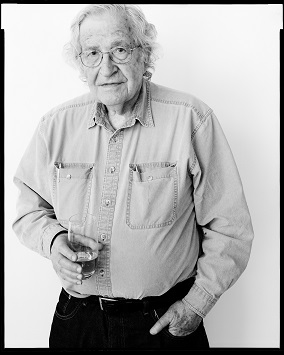
| NAME: Avram Noam CHOMSKY
PERSONAL: Born December 7, 1928, in Philadelphia, Pa.; son of
William (a Hebrew scholar) and Elsie (Simonofsky) Chomsky; married
Carol Schatz (a linguist and specialist in educational technology),
December 24, 1949; children: Aviva, Diane, Harry Alan.
ADDRESSES: Home--15 Suzanne Rd., Lexington, Mass. 02173.
Office--Department of Linguistics and Philosophy, Massachusetts
Institute of Technology, Room 20D-219, 77 Massachusetts Ave.,
Cambridge, Mass. 02139.
EDUCATION: University of Pennsylvania, B.A., 1949, M.A., 1951,
Ph.D., 1955.
CAREER: Massachusetts Institute of Technology, Cambridge, assistant
professor, 1955-58, associate professor, 1958-62, professor, 1962-65,
Ferrari P. Ward Professor of Modern Languages and Linguistics,
1966-76, Institute Professor, 1976--. Visiting professor of
linguistics, Columbia University, 1957-58, University of California,
Los Angeles, 1966, University of California, Berkeley, 1966-67, and
Syracuse University, 1982. Member, Institute of Advanced Study,
Princeton University, 1958-59. John Locke lecturer, Oxford University,
1969; Bertrand Russell Memorial Lecturer, Cambridge University, 1971;
Nehru Memorial Lecturer, University of New Delhi, 1972; Huizinga
Lecturer, University of Leiden, 1977; Woodbridge Lecturer, Columbia
University, 1978; Kant Lecturer, Stanford University, 1979.
POLITICS: Libertarian socialist.
MEMBERSHIPS: National Academy of Sciences, American Academy of Arts
and Sciences, Linguistic Society of America, American Philosophical
Association, American Association for the Advancement of Science,
British Academy (corresponding fellow), British Psychological Society
(honorary member), Deutsche Akademie der Naturforscher Leopoldina,
Utrecht Society of Arts and Sciences.
AWARDS: Junior fellow, Harvard Society of Fellows, 1951-55;
research fellow at Harvard Cognitive Studies Center, 1964-67; named
one of the "makers of the twentieth century" by the London Times,
1970; Guggenheim fellowship, 1971-72; distinguished scientific
contribution from American Psychological Association, 1984; Gustavus
Myers Center Award, 1986 and 1988; George Orwell Award, National
Council of Teachers of English, 1987; Kyoto Prize in Basic Sciences,
1988. Honorary degrees include D.H.L. from University of Chicago,
1967, Loyola University of Chicago and Swarthmore College, 1970, Bard
College, 1971, University of Massachusetts, 1973, and University of
Pennsylvania, 1984; and D.Litt. from University of London, 1967, Delhi
University, 1972, Visva-Bharati University (West Bengal), 1980.
WRITINGS:
Syntactic Structures, Mouton & Co., 1957, reprinted, 1978.
Current Issues in Linguistic Theory, Mouton & Co., 1964.
Aspects of the Theory of Syntax, M.I.T. Press, 1965, reprinted,
1986.
Cartesian Linguistics: A Chapter in the History of Rationalist
Thought, Harper, 1966.
Topics in the Theory of Generative Grammar, Mouton & Co., 1966,
reprinted, 1978.
(With Morris Halle) Sound Patterns of English, Harper, 1968.
Language and Mind, Harcourt, 1968, enlarged edition, 1972.
American Power and the New Mandarins, Pantheon, 1969.
At War with Asia, Pantheon, 1970.
Problems of Knowledge and Freedom: The Russell Lectures, Pantheon,
1971.
(With George A. Miller) Analyse formelle des langues naturelles,
Mouton & Co., 1971.
Studies on Semantics in Generative Grammar, Mouton & Co., 1972.
(Editor with Howard Zinn) The Pentagon Papers, Volume 5: Critical
Essays, Beacon Press, 1972.
(With Edward Herman) Counterrevolutionary Violence, Warner Modular,
Inc., 1974.
Peace in the Middle East?, Pantheon, 1975.
The Logical Structure of Linguistic Theory, Plenum, 1975.
Reflections on Language, Pantheon, 1975.
Essays on Form and Interpretation, North-Holland, 1977.
Dialogues avec Mitsou Ronat, Flammarion, 1977, translation
published as Language and Responsibility, Pantheon, 1979.
Human Rights and American Foreign Policy, Spokesman, 1978.
(With Herman) The Political Economy of Human Rights, South End,
1979, Volume I: The Washington Connection and Third World Fascism,
Volume II: After the Cataclysm: Postwar Indochina and the Construction
of Imperial Ideology.
Rules and Representations, Columbia University Press, 1980.
Language and Learning: The Debate between Jean Piaget and Noam
Chomsky, edited by Massimo Piattelli-Palmarini, Harvard University
Press, 1980.
Lectures on Government and Binding, Foris, 1981.
Radical Priorities, Black Rose Books, 1981.
Towards a New Cold War: Essays on the Current Crisis and How We Got
There, Pantheon, 1982.
Noam Chomsky on the Generative Enterprise: A Discussion with Riny
Huybregts and Henk van Riemsdijk, Foris, 1982.
(With Jonathan Steele and John Gittings) Superpowers in Collision:
The Cold War Now, Penguin Books, 1982.
Some Concepts and Consequences of the Theory of Government and
Binding, M.I.T. Press, 1982.
The Fateful Triangle: The United States, Israel, and the
Palestinians, South End, 1983.
Turning the Tide: U.S. Intervention in Central America and the
Struggle for Peace, South End, 1985.
Barriers, M.I.T. Press, 1986.
Knowledge of Language: Its Nature, Origins, and Use, Praeger, 1986.
Pirates and Emperors: International Terrorism in the Real World,
Claremont, 1986.
On Power and Ideology: The Managua Lectures, South End, 1987.
The Chomsky Reader, edited by James Peck, Pantheon, 1987.
Language and Problems of Knowledge: The Managua Lectures, M.I.T.
Press, 1987.
Language in a Psychological Setting, Sophia University (Tokyo),
1987.
Generative Grammar: Its Basis, Development, and Prospects, Kyoto
University of Foreign Studies, 1988.
The Culture of Terrorism, South End, 1988.
(With Edward S. Herman) Manufacturing Consent: The Political
Economy of the Mass Media, Pantheon, 1988.
Necessary Illusions: Thought Control in a Democratic Society, South
End, 1989.
Language and Politics, edited by Carlos P. Otero, Black Rose Books,
1989.
Contributor of numerous articles to scholarly and general
periodicals.
SIDELITES: "Judged in terms of the power, range, novelty and
influence of his thought, Noam Chomsky is arguably the most important
intellectual alive today," writes Paul Robinson in the New York Times
Book Review. Chomsky, a professor of linguistics at the Massachusetts
Institute of Technology, has attracted worldwide attention with his
ground-breaking research into the nature of human language and
communication. As the founder of the "Chomskyan Revolution," the
scholar has become the center of a debate that transcends formal
linguistics to embrace psychology, philosophy, and even genetics. New
York Times Magazine contributor Daniel Yergin maintains that Chomsky's
"formulation of 'transformational grammar' has been acclaimed as one
of the major achievements of the century. Where others heard only a
Babel of fragments, he found a linguistic order. His work has been
compared to the unraveling of the genetic code of the DNA molecule."
Yergin further contends that Chomsky's discoveries have had an impact
"on everything from the way children are taught foreign languages to
what it means when we say that we are human." Chomsky is also an
impassioned critic of American foreign policy, especially as it
affects ordinary citizens of Third World nations. Many of his books
since 1969 concern themselves with "the perfidy of American influence
overseas," to quote Atlantic essayist James Fallows. In America,
Kenneth J. Gavin finds a unifying strain in all of Chomsky's various
writings. The author's goal, says Gavin, is "to highlight principles
of human knowledge and indicate the priority of these principles in
the reconstruction of a society. His efforts leave us with more than
enough to think about."
Chomsky was born in Philadelphia on December 7, 1928. His father
was a Hebrew scholar of considerable repute, so even as a youngster
Chomsky "picked up a body of informal knowledge about the structure
and history of the Semitic languages," according to David Cohen in
Psychologists on Psychology. While still in high school Chomsky
proofread the manuscript of his father's edition of a medieval Hebrew
grammar. Yergin notes: "This backdoor introduction to 'historical
linguistics' had considerable impact in the future; it helped fuel his
later conviction that the explanation of how language worked, rather
than categories and description, was the business of linguistic
study." The young Chomsky was more interested in politics than
grammar, however. He was especially passionate about the rebirth of a
Jewish culture and society in what later became the state of Israel,
and for a time he entertained the idea of moving there. In 1945 he
enrolled at the University of Pennsylvania, where he came under the
influence of Zellig Harris, a noted professor of linguistics. John
Lyons observes in Noam Chomsky that it was the student's "sympathies
with Harris's political views that led him to work as an undergraduate
in linguistics. There is a sense, therefore, in which politics brought
him into linguistics."
The school of linguistics in which Chomsky took his collegiate
training held as its goal the formal and autonomous description of
languages without wide reference to the meaning--or semantics--of
utterances. Lyons elaborates: "Semantic considerations were strictly
subordinated to the task of identifying the units of phonology and
syntax and were not involved at all in the specification of the rules
or principles governing their permissible combinations. This part of
the grammar was to be a purely formal study, independent of
semantics." Chomsky questioned this approach in his early work in
generative grammar as a student at the University of Pennsylvania and
broke with it more radically while in the Harvard Society of Fellows
from 1951. There he was immersed in new developments in mathematical
logic, the abstract theory of thinking machines, and the latest
psychological and philosophical debates. These ideas led him to
develop further his earlier work on generative grammar and to ask
"precise and formal questions about linguistics and language," to
quote Justin Leiber in his work Noam Chomsky: A Philosophical
Overview. Leiber adds: "His results led him to criticize and discard
the prevailing views in linguistics."
What Chomsky began to develop in the 1950s was a mathematically
precise description of some of human language's most striking
features. Yergin contends that the scholar was "particularly
fascinated by 'generative systems'--the procedures by which a
mathematician, starting with postulates and utilizing principles and
inferences, can generate an infinite number of proofs. He thought that
perhaps language was 'generated' from a few principles as well."
Yergin claims that this line of reasoning led Chomsky to another
salient question, namely: "How is it possible that, if language is
only a learned habit, one can be continually creative and innovative
in its use?" This question--and its explication--would provide a novel
and compelling critique of two established fields, traditional
structural linguistics and behavioral psychology. Leiber concludes
that Chomsky's new theory "explained many features of language that
were beyond structuralist linguistics and placed the specific data,
and many lower-level generalizations, of the structuralists within a
richer theory."
Many of Chomsky's novel ideas saw print in his first book,
Syntactic Structures, published in 1957. Yergin calls the work "the
pale blue book ... which heralded the Chomskyan Revolution." He adds
that the volume "demonstrated that important facts about language
could not be explained by either structural linguistics or by computer
theory, which was then becoming fashionable in the field. In
'Syntactic Structures,' Chomsky departed from his mentors in stressing
the importance of explaining creativity in language and introduces his
own transformational grammar as a more 'powerful' explanation of how
we make sentences." Webster Schott offers a similar assessment in the
Washington Post Book World. In Syntactic Structures, writes Schott,
"Chomsky (presents) and (seems) to demonstrate the proposition that
every human being has an innate ability to acquire language, and this
ability to learn language is called into use when one hears, at the
right age, language for the first time. He also (offers) a concept--it
came to be known as 'generative' or 'transformational-generative'
grammar--which (has) made it possible to predict ('generate') the
sentence combinations in a language and to describe their structure."
Lyons states that the short and relatively nontechnical Syntactic
Structures "revolutionized the scientific study of language."
The proofs Chomsky uses for his theories are complex, but his
conclusions are readily accessible. Robinson observes that, put as
simply as possible, Chomsky's view holds that "the ability to speak
and understand a language cannot be explained in purely empirical
terms--that is, purely by induction. When we 'learn' a language, he
says, we are able to formulate and understand all sorts of sentences
that we've never heard before. What we 'know,' therefore, must be
something deeper--a grammar--that makes an infinite variety of
sentences possible. Chomsky believes that the capacity to master
grammatical structures is innate: It is genetically determined, a
product of the evolutionary process, just as the organic structures of
our bodies are." A strict "stimulus-response" mechanism cannot
adequately account for the way young children master language during
the first four years of life; the child, to quote Cohen, "learns ...
to extract the more complex rules of grammar needed for speech."
Leiber explains that for Chomsky, then, the primary interest of the
linguist should be with specifying the "device of some sort" that
generates an infinite variety of grammatically-correct sentences.
"This device will specify what is somehow 'internalized' in the
competent speaker-hearer of the language," Leiber writes. "Though the
most usual label for Chomsky's general sort of linguistics is
'transformational-generative linguistics,' the most crucial word is
'generative'--as opposed to 'taxonomical'--since the primary concern
is with the 'principles and processes by which sentences are
constructed in particular languages,' not with the identification and
classification of items found in the surface end product of these
principles and processes."
One of the mechanisms Chomsky proposes for sentence generation is
the "deep structure-surface structure" scenario. According to Yergin,
the surface structure "'faces out' on the world and, by certain
phonological rules, is converted into the sounds we hear; it
corresponds to the parsing of sentences which we all learned from our
indefatigable junior high English teachers. The deep structure 'faces
inward' toward the hazy region of conceptualization, is more abstract
and related to meaning. It expresses the basic logical relations
between nouns and verbs." Transformational grammar therefore "consists
of a limited series of rules, expressed in mathematical notation,
which transform deep structures into well-formed surface structures.
The transformational grammar thus relates meaning and sound." Cohen
discusses the applications of this concept. "Chomsky has analysed the
necessary constituents of the deep structure and the transformations
through which this deep structure is turned into the surface structure
we recognize and use as sentences. He has, of course, extended his
theory from this point into the implications for our knowledge of man
that comes from the fact that our knowledge of language is based upon
this deep structure, a structure that we cannot guess or divine just
from speaking, and upon the necessary transformations."
Chomsky has argued that all natural human languages possess deep
and surface structures and cycles of transformations between them. In
the Nation, Gilbert Harman writes: "These built-in aspects of grammar
will be parts of the grammar of every language. They are, in other
words, aspects of 'universal grammar.' We must therefore suppose that
people have a specific faculty of language, a kind of 'mental organ'
which develops in the appropriate way, given appropriate experience,
yielding a knowledge of whatever language is spoken in their
community." John Sturrock elaborates in the New York Times Book
Review: "Chomskyism starts with grammar and finishes in genetics.
Drill deep enough into the structure of our sentences, he maintains,
and you will come to those ultimate abstractions with which we were
born, the grammar of any given language being originally determined by
the fairly restricted grammatical possibilities programmed in the
brain.... DNA sets up to master a syntax, the accident of birth
determines which one." Needless to say, not everyone agrees with
Chomsky's view. Psychology Today contributor Howard Gardner calls the
human being in Chomsky's formulation "a totally preprogrammed
computer, one that needs merely to be plugged into the appropriate
outlet." Lyons, conversely, states that Chomsky "was surely right to
challenge 'the belief that the mind must be simpler in its structure
than any known physical organ and that the most primitive of
assumptions must be adequate to explain whatever phenomena can be
observed.'"
Obviously, Chomsky's theory has as much to do with psychology and
philosophy as it does with linguistics. For instance, the very
premises of the scholar's work have made him one of the most
devastating critics of behaviorism, the view that suggests all human
responses are learned through conditioning. Sturrock notes: "Chomsky's
case is that ... that fanatical core known as behaviorism, has a
theory of learning, all rote and Pavlovian reinforcement, which is
deficient and, in the end, degrading.... (Behaviorists), given their
sinister theory of learning, must be proponents of the view that human
nature is not nature at all, but a social product conditioned from
outside. Chomsky finds hope and a decisive guarantee of intellectual
freedom in the cognitive structures which sit incorruptibly in the
fastness of our brains." Chomsky's work reinforces the philosophical
tradition of "rationalism," the contention that the mind, or "reason,"
contributes to human knowledge beyond what is gained by experience. He
is opposed by the "empiricists," who claim that all knowledge derives
from external stimuli, including language. In the Nation, Edward
Marcotte declares: "What started as purely linguistic research ... has
led, through involvement in political causes and an identification
with an older philosophic tradition, to no less than an attempt to
formulate an overall theory of man. The roots of this are manifest in
the linguistic theory.... The discovery of cognitive structures common
to the human race but only to humans (species specific), leads quite
easily to thinking of unalienable human attributes." Leiber concludes:
"Mind is the software of human psychology, and thought is individuated
as instances of the mind's operations. The behaviorist is seen to be
insisting ... on a very minimal sort of software; the rationalist is
out to show that much more powerful and abstract, perhaps in good
measure innate, software has to be involved. One can feel unhappy with
Chomsky's particular way of putting, or productively narrowing, the
issue, but it is not an unreasonable viewpoint. Chomsky has an
interesting and important sense of know at hand. He is looking at men
in a way that has an established and well-defined sense when applied
to thinking devices."
While establishing his academic reputation, Chomsky continued to be
concerned about the direction of American politics and ideology. His
moral indignation rose in the 1960s until he became "one of the most
articulate spokesmen of the resistance against the Vietnam war," to
quote Jan G. Deutsche in the New York Times Book Review. Chomsky
attacked the war in articles, in books, and from the podium; in the
process he became better known for his political views than for his
linguistic scholarship. In a New York Times piece written during that
era, Thomas Lask observes: "Unlike many others, even those who oppose
the war, Noam Chomsky can't stand it and his hatred of what we are
doing there and his shame, as well as his loathing for the men who
defend and give it countenance are tangible enough to touch." Nation
essayist Brian Morton finds "nothing exotic about his critique of the
U.S. role in Vietnam: He attempted no analysis of arcane economic or
political structures. All he did was evaluate our government's actions
by the same standards that we apply when we evaluate the actions of
other governments."
Chomsky's first book-length work on Vietnam, American Power and the
New Mandarins, offers "a searing criticism of the system of values and
decision-making that drove the United States to the jungles of
Southeast Asia," according to Michael R. Beschloss in the Washington
Post Book World. The book's strongest vitriol is directed toward those
so-called "New Mandarins"--the technocrats, bureaucrats, and
university-trained scholars who defend America's right to dominate the
globe. Deutsch states that Chomsky's concern "is not simply that
social scientists have participated widely in designing and executing
war-related projects. What he finds disturbing are the consequences of
access to power by intellectuals; the difficulties involved in
retaining a critical stance toward a society that makes the reward of
power available as well as the need to be 'constructive,' the
recognition as problems of only those difficulties that are soluble by
the means at hand." Inevitably, Chomsky's volume has drawn scathing
criticism from those who oppose his views and high praise from those
who agree with him. Chicago Tribune Book World reviewer Arthur
Schlesinger, Jr., claims: "Judging by American Power and the New
Mandarins, one can only conclude that Chomsky's idea of the
responsibility of an intellectual is to forswear reasoned analysis,
indulge in moralistic declamation, fabricate evidence when necessary
and shout always at the top of one's voice. It need hardly be said
that, should the intellectual community follow the Chomsky example, it
would betray its own traditions and hasten society along the road to
unreason and disaster." In the Nation, Robert Sklar feels otherwise
about the work. The critic contends: "The importance of American Power
and the New Mandarins lies in its power to free our minds from old
perspectives, to stimulate new efforts at historical, political and
social thought."
Subsequent Chomsky books on American foreign policy have explored
other political hotbeds around the world, drawing the conclusion that
U.S. interests in human rights, justice, and morality are inevitably
subordinated to big business profit-taking. As Beschloss notes,
Chomsky's "is a portrait of corporate executives manipulating foreign
policy for profit motives, of Third World peoples devastated for
drifting away from the American 'grand area' of influence; of
hand-maiden journalists, politicians, and intellectuals shrouding the
darker realities of American statecraft under platitudes about
idealism and goodwill with an eye toward their flow of rewards from
the Establishment." Times Literary Supplement correspondent Charles
Townshend observes that Chomsky "sees a 'totalitarian mentality'
arising out of the mainstream American belief in the fundamental
righteousness and benevolence of the United States, the sanctity and
nobility of its aims. The publicly tolerated 'spectrum of discussion'
of these aims is narrow." Chomsky himself transcends that narrow
spectrum, adducing "example after example to illuminate how American
policies have led knowingly to large scale human suffering," to quote
Beschloss. In the New York Times Book Review, Sheldon S. Wolin
suggests that the author "is relentless in tracking down official lies
and exposing hypocrisy and moral indifference in the high places....
Yet the passion of Chomsky's indictment is always controlled, and
while he is harsh toward his opponents, he is never unfair or
arrogant."
Other critics have been less sanguine about Chomsky's political
views; in fact, some have actually labeled him a pariah and attempted
to discredit him on a number of grounds. "It has been Chomsky's
singular fate to have been banished to the margins of political
debate," writes Steve Wasserman in the Los Angeles Times Book Review.
"His opinions have been deemed so kooky--and his personality so
cranky--that his writings no longer appear in the forums ... in which
he was once so welcome." Wolin offers one dissenting view: "Chomsky's
political writings are curiously untheoretical, which is surprising in
a writer renowned for his contributions to linguistic theory. His
apparent assumption is that politics is not a theoretical subject....
One gets the impression from reading Chomsky that if it were not
urgently necessary to expose lies, immorality and the abuse of power,
politics would have no serious claim upon the theoretical mind." New
York Times Book Review contributor Paul Robinson notes that in
Chomsky's case, "the popular or accessible (political) works often
seem to belie the intellectual powers unambiguously established in the
professional works.... Indeed, one might argue that the discrepancy is
more extreme in his work than in that of any other important
intellectual." Morton feels that the attacks on Chomsky's
historical/political scholarship--and more recently the tendency to
ignore his work--have affected his level of stridency. The critic
observes, for instance, that "his later tone is that of a man who
doesn't expect anything to change.... Chomsky is savagely indignant
because the values he cherishes are being strangled. But increasingly,
the reasons for his indignation--the values he cherishes--are hard to
see in his work. Only the indignation is clear."
Chomsky has his champions, however. Leiber, for one, finds an
overriding commitment to freedom in the author's work--"the freedom of
the individual to produce and create as he will without the goad of
external force, economic competition for survival, or legal and
economic restraint on social, intellectual, or artistic experiment;
and the freedom of ethnic and national groups to work out their own
destinies without the intervention of one or another Big Brother."
"From his earliest writings to his latest, Chomsky has looked with
astonishment at what the powerful do to the powerless," Morton
declares. "He has never let his sense of outrage become dulled. If his
voice has grown hoarse over twenty years, who can blame him? And who
can feel superior? No one has given himself more deeply to the
struggle against the horrors of our time. His hoarseness is a better
thing than our suavity." Deutsch writes: "The most convincing
indication of the extent to which Chomsky's wide ranging indictment of
United States society and policy must be taken seriously is that a man
possessed of these sensibilities should have felt compelled to
undertake it." Morton offers a compelling conclusion. "Americans are
no longer convinced that our government has the right to destroy any
country it wants to," the essayist states. "And to the extent that
this is true, Chomsky, along with others like him, deserves much of
the credit. He did his job well."
In 1970, the London Times named Chomsky one of the thousand "makers
of the twentieth century." According to Yergin, his theory "remains
the foundation of linguistics today," and "his vision of a complex
universe within the mind, governed by myriad rules and prohibitions
and yet infinite in its creative potential, opens up vistas possibly
as important as Einstein's theories." Yergin adds: "The impact of
Chomsky's work may not be felt for years.... Yet this beginning has
revolutionized the study of language and has redirected and redefined
the broad inquiry into intelligence and how it works." Robinson calls
the scholar's work "a prolonged celebration of the enormous gulf that
separates man from the rest of nature. He seems overwhelmed by the
intellectual powers that man contains within himself. Certainly nobody
ever stated the case for those powers more emphatically, nor
exemplified them more impressively in his own work. Reading Chomsky on
linguistics, one repeatedly has the impression of attending to one of
the more powerful thinkers who ever lived."
Chomsky has also earned a place in history for his political
writings. According to Christopher Lehmann-Haupt in the New York
Times, Chomsky "continues to challenge our assumptions long after
other critics have gone to bed. He has become the foremost gadfly of
our national conscience." New Statesman correspondent Francis Hope
praises Chomsky for "a proud defensive independence, a good plain
writer's hatred of expert mystification, a doctrine of resistance
which runs against the melioristic and participatory current of most
contemporary intellectual life." Hope concludes: "Such men are
dangerous; the lack of them is disastrous."
SOURCES:
BOOKS;
Cohen, David, Psychologists on Psychology, Taplinger, 1977.
Contemporary Issues Criticism, Volume 1, Gale, 1982.
Greene, Judith, Psycholinguistics: Chomsky and Psychology, Penguin
Books, 1972.
Harman, Gilbert, editor, On Noam Chomsky: Critical Essays, Anchor
Press, 1974.
Kim-Renaud, Young-Key, Studies in Korean Linguistics, Hanshin
Publishing, 1986.
Leiber, Justin, Noam Chomsky: A Philosophical Overview, Twayne,
1975.
Lyons, John, Noam Chomsky, 2nd edition, Penguin Books, 1977.
Mehta, Ved, John Is Easy to Please, Farrar, Straus, 1971.
Osiatynski, Wiktor, Contrasts: Soviet and American Thinkers Discuss
the Future, Macmillan, 1984.
Rieber, Robert W., editor, Dialogues on the Psychology of Language
and Thought: Conversations with Noam Chomsky, Charles Osgood, Jean
Piaget, Ulric Neisser, and Marcel Kinsbourne, Plenum, 1983.
Sampson, Geoffrey, Liberty and Language, Oxford University Press,
1979.
Thinkers of the Twentieth Century, Gale, 1983.
PERIODICALS;
America, December 11, 1971.
Atlantic, July, 1973, February, 1982.
Book World, March 23, 1969.
Christian Century, July 23, 1969.
Christian Science Monitor, April 3, 1969, May 14, 1970.
Chronicle of Higher Education, May 12, 1982.
Commentary, May, 1969.
Dissent, January-February, 1970.
Economist, November 29, 1969.
Globe and Mail (Toronto), June 16, 1984, July 5, 1986.
Harvard Education Review, winter, 1969.
Horizon, spring, 1971.
International Affairs, January, 1971.
Los Angeles Times Book Review, December 27, 1981, June 8, 1986,
August 30, 1987.
Maclean's, August 18, 1980.
Nation, September 9, 1968, March 24, 1969, May 17, 1971, May 8,
1976, March 31, 1979, February 16, 1980, December 22, 1984, December
26, 1987-January 2, 1988, May 7, 1988.
National Review, June 17, 1969.
New Republic, April 19, 1969, October 26, 1974, March 13, 1976,
February 17, 1979, September 6-13, 1980, March 24, 1982, March 23,
1987.
New Statesman, November 28, 1969, August 17, 1979, April 25, 1980,
July 17, 1981, August 14, 1981, September 11, 1981, January 21, 1983.
Newsweek, March 24, 1969.
New Yorker, November 11, 1969, May 8, 1971.
New York Review of Books, August 9, 1973, January 23, 1975,
November 11, 1976, October 23, 1980.
New York Times, March 18, 1969, August 2, 1973, February 5, 1979,
March 8, 1982.
New York Times Book Review, March 16, 1969, January 17, 1971,
January 9, 1972, September 30, 1973, October 6, 1974, February 15,
1976, February 25, 1979, October 19, 1980, March 21, 1982, April 13,
1986.
New York Times Magazine, May 6, 1968, December 3, 1972.
Progressive, December, 1982.
Psychology Today, July, 1979.
Saturday Review, May 31, 1969.
Science and Society, spring, 1970.
Sewanee Review, winter, 1977.
Times Literary Supplement, March 27, 1969, March 31, 1972, December
21, 1973, December 12, 1975, September 10, 1976, November 21, 1980,
February 27, 1981, July 23, 1982, July 15-21, 1988.
Village Voice, June 18, 1980, June 23, 1980, July 13, 1982.
Virginia Quarterly Review, summer, 1969.
Washington Post Book World, March 11, 1979, March 7, 1982, February
21, 1988. |